
Myra Ancient City – Lycian Tombs & Roman Theatre in Demre
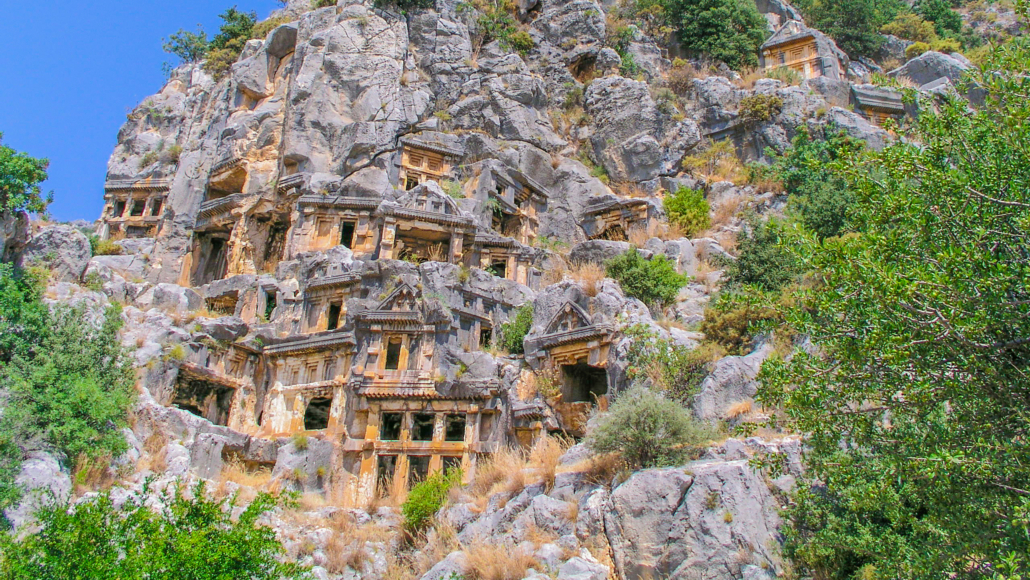
Myra Ancient City is one of the most visually striking and historically significant archaeological sites along Turkey’s Lycian Coast. Located near the modern town of Demre in Antalya Province, Myra is best known for its dramatic rock-cut Lycian tombs carved directly into towering limestone cliffs.
Unlike the grand Roman cities of Perge or Aspendos, Myra presents a layered cultural landscape shaped first by the Lycian civilisation and later expanded under Roman rule. Its proximity to the ancient harbour of Andriake connected it to Mediterranean trade routes, giving the city both economic and strategic importance.
Today, Myra stands as a powerful reminder of how inland settlements and maritime networks once shaped the eastern Mediterranean.
Why Visit Myra Ancient City?
- Monumental Lycian rock-cut tombs carved into vertical cliffs
- A large and well-preserved Roman theatre
- Connections to St. Nicholas and early Christian history
- Part of the Lycian League political network
Myra offers a unique blend of indigenous Anatolian culture and Roman architectural influence — all within a compact, walkable site.
The Lycian Rock-Cut Tombs
The tombs are Myra’s defining feature. Carved into steep limestone cliffs, they were designed to resemble wooden Lycian houses. According to Lycian belief, the dead were placed high above ground so winged creatures could carry souls to the afterlife.
Key Characteristics:
- Detailed façade carvings
- Columned entrances
- Relief panels depicting figures and scenes
The tombs date primarily from the 4th century BCE, reflecting the height of Lycian influence before full Roman integration.
The Roman Theatre
At the base of the cliffs stands a large Roman theatre, expanded during the 2nd century CE. With seating capacity for thousands, it demonstrates Myra’s prosperity under Roman rule.
Visitors can still observe:
- Decorated stage reliefs
- Vaulted entrances
- Multi-tiered seating rows
The theatre’s preservation makes it one of the most impressive along the Lycian Coast.
Myra in the Lycian League
Myra was an influential member of the Lycian League, a federation of cities that operated with a form of representative governance. This political system later inspired elements of modern democratic theory.
Its harbour at Andriake enabled economic growth through maritime trade, connecting Myra to wider Mediterranean routes.
Connection to St. Nicholas
Myra later became significant in early Christian history as the episcopal seat of St. Nicholas in the 4th century CE. The nearby St. Nicholas Church in Demre reflects this spiritual legacy.
How Long Do You Need at Myra?
- Minimum: 1.5–2 hours
- Recommended: 2–3 hours including detailed exploration
Pairing Myra with St. Nicholas Church creates a balanced half-day cultural visit.
Best Time to Visit Myra
- April–May: Comfortable for walking and photography
- June–September: Visit early morning due to heat
- October: Excellent light and moderate temperatures
- Winter: Quiet and atmospheric
Spring and autumn offer the most comfortable conditions for extended exploration.
How to Get to Myra
- Located in Demre, approx. 2.5–3 hours from Antalya
- 45 minutes from Kas
- Accessible by car or organised day tours
Myra works well within a Lycian Coast road trip itinerary.
Exploring the Coast Beyond Myra
Although Myra sits slightly inland today, its ancient prosperity depended on Andriake Harbour and Mediterranean trade networks. The coastline near Kekova still reveals sheltered bays and partially submerged ruins shaped by seismic shifts.
Experiencing the Lycian Coast from the sea provides context for Myra’s maritime connections. Traditional wooden gulets continue to navigate these waters, linking historic harbour towns and quiet anchorages along the Turkish Riviera.
Frequently Asked Questions
Is Myra Ancient City worth visiting?
Yes. The Lycian rock-cut tombs alone make it one of the most distinctive archaeological sites in Turkey.
How long should you spend at Myra?
Plan for at least two hours to fully explore the theatre and tomb area.
Is Myra suitable for families?
Yes, though climbing on ruins is restricted and surfaces may be uneven.
Is Myra crowded?
It receives tour groups, especially in summer, but remains manageable outside peak midday hours.
Can you combine Myra with Kekova?
Yes. Many visitors explore Myra in the morning and take a boat trip to Kekova in the afternoon.
When is the best season to visit?
Spring and autumn provide the most comfortable temperatures.
Is Myra part of the Lycian Way?
Yes. The Lycian Way long-distance hiking route passes near Demre and surrounding areas.
Final Perspective
Myra Ancient City represents the cultural and political strength of the Lycian civilisation while reflecting centuries of Roman and early Christian influence. Its cliff-carved tombs, monumental theatre, and maritime connections make it one of the defining historical sites of the Lycian Coast. Approached within a broader coastal journey, Myra reveals how land and sea once operated as a unified Mediterranean system.